
Sharon Hodgson MP's report - July-Sep 2026 - number 192
Sharon Hodgson MP's report - News from Westminster - July-Sep 2026 - number 192
Sharon Hodgson MP's report - July-Sep 2026 - number 192
Sharon Hodgson MP's report - July-Sep 2026 - number 192 Sharon Hodgson MP's report - News from Westminster - July-Sep 2026 - number 192 Read more
Sharon Hodgson MP's report - Jun-July 2026 - number 191
Sharon Hodgson MP's report - News from Westminster - Jun-July 2026 - number 191
> Sharon Hodgson MP's report - Jun-July 2026 - number 191
Sharon Hodgson MP's report - Jun-July 2026 - number 191 Sharon Hodgson MP's report - News from Westminster - Jun-July 2026 - number 191 Read more
> Read the whole debate in Hansard here - SMA Debate 22/06/2026 >
Text of Sharon Hodgson MP's speech, from Hansard:
7.14pm
The Parliamentary Under-Secretary of State for Health and Social Care
Mrs Sharon Hodgson
It is a pleasure to serve under your chairmanship, Mr Mundell. I thank my constituency neighbour, my hon. Friend the Member for Sunderland Central (Lewis Atkinson), for opening the debate on behalf of the Petitions Committee. It is very heartening to see so many Members in the Chamber and so many families in the Public Gallery, all united by a shared concern for children and families affected by spinal muscular atrophy.
SMA is a cruel and devastating condition. It can steal from a family the carefree future they had imagined for their child. It can take away a child’s mobility and, far too often, it can take away a child’s life far too soon. I pay tribute to children living with SMA for their courage, to their families for their strength, and to campaigners for working tirelessly to ensure that their voices are heard. Their message to us is clear: where there is a chance to identify affected babies earlier, and where treatment may have its greatest effect, we must pursue that chance with urgency, care and resolve.
I particularly thank Jesy Nelson, who is in the Public Gallery and is very welcome. She is so brave to share her experience of the condition, which affects her twins, Ocean and Story. She has given a public voice to all those going through a similar experience. This petition has rightly gained significant support—150,000 signatures —in such a short space of time. I am so pleased that we can take the time to have this debate and raise awareness of SMA.
I assure everyone that this conversation will not stop today. I will continue to listen to the voices of those speaking for children with SMA. Tomorrow, for example, I am due to meet with members of Muscular Dystrophy UK to continue this very conversation. I know that many families and advocates feel that the Government have moved too slowly towards a decision on screening for SMA. I understand that frustration, but decisions about national screening programmes must be made with great care.
We must be confident that screening will do more good than harm, that it can be delivered safely and fairly, and that we are making the best possible use of NHS resources for the babies and families who depend on them. There remain many unanswered questions about the benefits and practical delivery of screening for SMA. That matters because the answer we seek must be robust enough to support a lasting national programme.
We were pleased that the National Institute for Health and Care Excellence published final guidance earlier this year accepting both nusinersen and risdiplam as treatments that could be routinely offered to SMA patients for whom gene therapy has not worked. The finding that those treatments can improve survival rates and slow the progression of disease is welcome and significant. For families living with SMA, even slowing that progression can mean more time, more independence, more moments together and more hope.
Ruth Jones
The Minister says that screening must be safe and fair. We know the benefits of screening—the people in the Public Gallery have articulated it so clearly. The benefits are undeniable, so is it fair that the whole of Wales and a third of England does not have such screening?
Mrs Hodgson
I was going to come to the point about labs, but let me address it now. My hon. Friends the Members for Newport West and Islwyn (Ruth Jones) and for Portsmouth North (Amanda Martin); the hon. Member for Keighley and Ilkley (Robbie Moore); the shadow Secretary of State, the right hon. Member for Daventry (Stuart Andrew); and others have made that very point. The trials will be rolled out to seven of the 13 labs, which leaves six labs outside the trial. I am told that the reason is that, as it is such a rare condition, the trial has to be broad enough to ensure a robust evidence base. The six not included do not currently have the requisite equipment. If that changes, more labs could be included.
Amanda Martin
I thank the Minister, who I respect her massively, for her comments. Portsmouth hospital is part of the generation study, so it is already able to test for the condition and could have rolled out the evaluation had it been included in the trials. It seems very strange that we are able to test babies in the generation study but not across the board.
Mrs Hodgson
I thank my hon. Friend for that intervention. My hon. Friend the Member for Sunderland Central also mentioned the generation study. There are lots of questions around this, and, as I am sure my hon. Friend the Member for Portsmouth North is aware, in preparing for this debate, I have been asking lots of those questions. I will take that point away and get back to her.
As we have heard, spinal muscular atrophy affects every part of daily life for the children and families involved: their routines, milestones, plans and the hopes that families hold for their children. Any progress against it matters deeply. At the same time, NICE has been clear that important questions remain, including around longevity and how long the benefits of these relatively new treatments may last. Those questions, alongside important issues of feasibility, must be answered before a national screening decision can be made.
That is why my Department has worked with the National Institute for Health and Care Research and NHS England to establish an in-service evaluation. That evaluation will run within the routine newborn blood spot screening programme to gather the evidence that we need, help answer difficult questions and fill the gaps that stand between us and a confident national decision. Crucially, the Department has worked alongside patient advocate groups, including the SMA NBS Alliance and SMA UK. I commend both groups for their excellent support and advocacy. They help to ensure that families’ voices are not an afterthought but are at the heart of decisions.
I acknowledge that, as we have heard, many have been frustrated by the pace of planning for this large-scale scientific evaluation. I hear that frustration—I really do—but we must get this right, because only a strong evaluation will give us the answers that families deserve and the evidence that a national programme requires.
Ruth Jones
I appreciate what the Minister says about getting evaluation right, but Ukraine can install such an evaluation across the whole country during a war, and Ireland is doing it, too, so why aren’t we?
Mrs Hodgson
Again, I have heard my hon. Friend’s remarks. They are not falling on deaf ears, as I am sure she is aware.
The previous Secretary of State, my right hon. Friend the Member for Ilford North (Wes Streeting), met Jesy Nelson, along with Giles Lomax from SMA UK, and I know that that had a massive impact on him. They spoke at length about what is needed; he listened and we acted. That is why I was very happy to announce just last month that the planned start date of January 2027 would be brought forward by three months. The new start date for the in-service evaluation will be October 2026. From that date, babies will begin to be screened for SMA, and we will begin collecting the essential information needed to help many more children in the years ahead.
Robbie Moore
I am pleased that that announcement was made, but, as I reiterated in my speech, that provision does not include West Yorkshire or my Keighley and Ilkley constituents. The Minister said that a broadbrush approach was needed to gain data, and that has been rolled out to the areas that the Government have already announced, but surely it is necessary to include all areas, as many Members said. Will the Minister meet me or write to me about what steps can be taken to include areas such as West Yorkshire, Leeds, and Keighley and Ilkley as part of the screening programme?
Mrs Hodgson
I have asked those very same questions. As it is such a broad trial, the small number that is not covered does lead me to ask those questions. I have not given up asking those questions, but for today, the answer is the same as the one I gave to my hon. Friend the Member for Newport West and Islwyn.
Peter Dowd
A group of SMA experts wrote an article in The Lancet in February 2025 entitled “The human toll of slow decisions”. They recommended that
“expert opinion and international evidence should be more thoroughly integrated into the decision-making process of NSCs”
and that
“the decision of independent bodies such as the NSC should be subject to scrutiny by the Ministry of Health, given the substantial effect of failing in the duty of care.”
The evidence and experience are there, but we are lagging behind. I hope the Minister agrees that we must stop taking a conservative approach to this. Children’s and families’ lives are at risk, and it has to stop.
Mrs Hodgson
I thank my hon. Friend for his passionate intervention. I say again that it does not fall on deaf ears.
The right hon. Member for Melton and Syston (Edward Argar) asked what steps can be taken to speed up the process. We will be working at pace. Again, I will be paying very close personal attention to that.
Let me refer to a few other comments that I have not touched on yet. My hon. Friend the Member for Sunderland Central asked about the unscreened community being used as a control or comparison group. I want to be very clear that those not included in the trial are not being used as a control or comparison group. Labs taking part in the study start to screen newborns for SMA in phases, and the labs act as the control before they start to screen.
My hon. Friend the Member for Blaydon and Consett (Liz Twist) asked when coverage will reach the whole of England. Again, this is about the six labs that are not covered. The Secretary of State is actively considering that, which is why I said that we are listening and working at pace.
My hon. Friend the Member for Newport West and Isl—[Laughter.] She asked whether we had spoken to Wales. It is a good job they do not send me to speak to Wales, because I cannot pronounce all the names! We work in close collaboration with the devolved Governments, who were all included in discussions about setting up the ISE.
The shadow Secretary of State, the right hon. Member for Daventry, asked a number of detailed questions. I will endeavour to write to him on those points. We have chosen areas with labs with the equipment needed to do the analysis, which is why I will write to my hon. Friend the Member for Portsmouth North about the generation study.
We must move forward with compassion for families, rigour in the evidence and determination to give every child the best possible start in life, and that is what will do. I thank all hon. Members for their excellent speeches and for the challenge about the pace and coverage of the clinical trial. I hear them all and feel their pain deeply. The House should believe me when I say that I asked all those questions while preparing for the debate. I commit to them all that I will continue to ask those questions on their behalf. Where we can go further and faster safely, I will push for that to be the case. This debate has played a very important part in that push. I thank Jesy, all the petitioners and all hon. Members for ensuring that this debate took place today.
David Mundell
(in the Chair)
Mr Atkinson, you have one minute to wind up.
7.29pm
> Read Sharon's speech on TheyWorkForYou >
> Back to top of page >
Sharon Hodgson MP - SMA debate speech - Westminster Hall - 22-06-2026
> Read the whole debate in Hansard here - SMA Debate 22/06/2026 >Text of Sharon Hodgson MP's speech, from Hansard:7.14pm The Parliamentary Under-Secretary of State for Health and Social Care ...
Sharon Hodgson MP's report - May-Jun 2026 - number 190

Sharon Hodgson MP's report - News from Westminster - May-Jun 2026 - number 190
> Sharon Hodgson MP's report - May-Jun 2026 - number 190
Sharon Hodgson MP's report - May-Jun 2026 - number 190 Sharon Hodgson MP's report - News from Westminster - May-Jun 2026 - number 190 Read more
Sharon Hodgson MP's report - Mar-May 2026 - number 189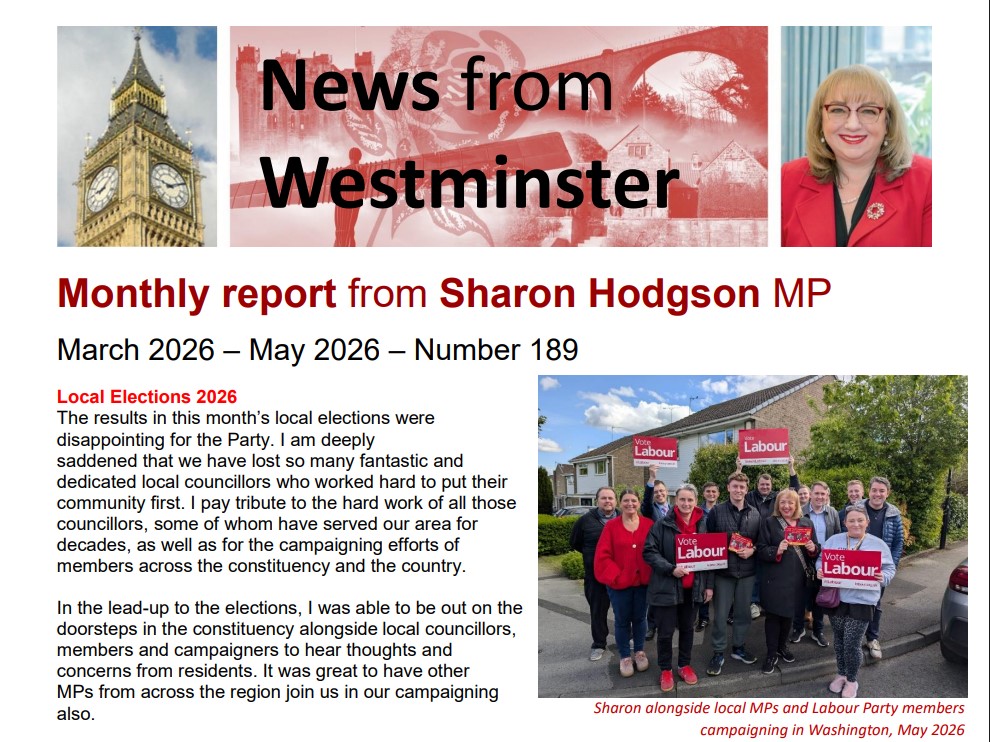
Sharon Hodgson MP's report - News from Westminster - Mar-May 2026 - number 189
> Sharon Hodgson MP's report - Mar-May 2026 - number 189
Sharon Hodgson MP's report - Mar-May 2026 - number 189 Sharon Hodgson MP's report - News from Westminster - Mar-May 2026 - number 189 Read more
Sharon Hodgson MP's report - Feb-Mar 2026 - number 188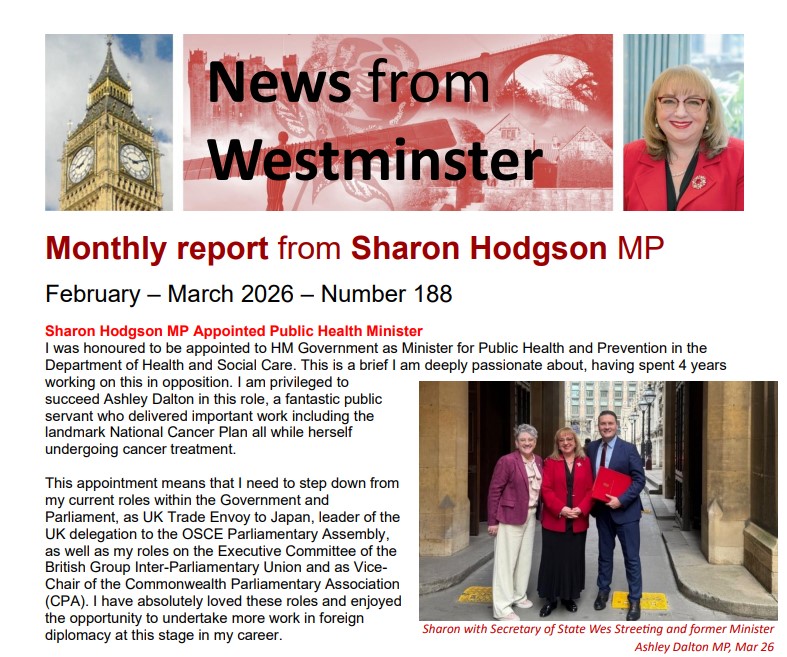
Sharon Hodgson MP's report - News from Westminster - Feb-Mar 2026 - number 188
Sharon Hodgson MP's report - Feb-March 2026 - number 188
Sharon Hodgson MP's report - Feb-Mar 2026 - number 188 Sharon Hodgson MP's report - News from Westminster - Feb-Mar 2026 - number 188 Read more
Sharon Hodgson MP's report - Dec 2025 - Feb 2026 number 187
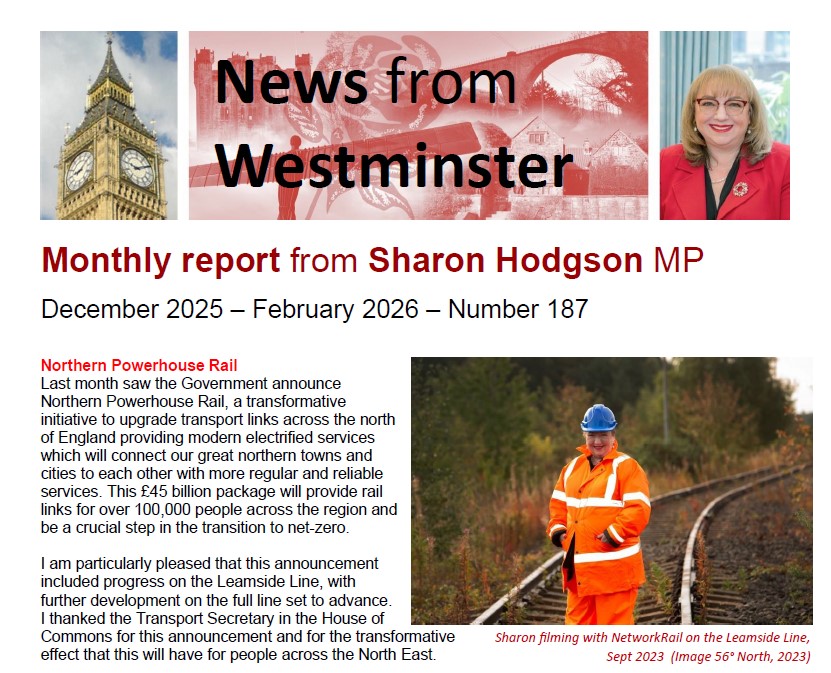
Sharon Hodgson MP's report - Dec 2025 - Feb 2026 number 187
Sharon Hodgson MP's report - Dec 2025 - Feb 2026 number 187 Read more
Sharon Hodgson MP: Northern Powerhouse Rail is a huge win for the North East and will be transformative for thousands.
ECHO COLUMN: Northern Powerhouse Rail is a huge win for the North East
Sharon Hodgson MP: Northern Powerhouse Rail is a huge win for the North East and will be transformative for thousands. Read more
Season's Greetings from Sharon Hodgson MP - 2025
Season's Greetings from Sharon Hodgson MP - 2025
Season's Greetings from Sharon Hodgson MP - 2025 Read more
Net Zero Transition: Consumer-led Flexibility debate, Westminster Hall
That this House has considered consumer-led flexibility for a just transition.
09/12/2025 - 09.38am
Mrs Sharon Hodgson
(Washington and Gateshead South) (Lab)
It is an honour to serve under your chairmanship, Mr Vickers. I thank the hon. Member for Thornbury and Yate (Claire Young) for securing this debate.
As we know, the Government have declared a clean power 2030 mission, which aims to achieve a target of 12 GW in consumer-led flexibility. Earlier this year, the Government also published their landmark “Clean Flexibility Roadmap”, which I fully support and which formally recognises consumer-led flexibility as essential for energy security and will lower bills for more than 4,000 households in fuel poverty in my constituency. I have campaigned extensively, over my whole parliamentary career, on fuel poverty. I cannot beat the Minister, who comes from Scotland, but the north-east tends to be one of the colder parts of the UK, so that issue is very important. Consumer-led flexibility is essential for a just transition. Unlocking just 10 GW of consumer-led flexibility by 2030 is equal to a third of the UK’s entire gas power station capacity.
I will start by highlighting some of the impressive developments taking place in my constituency of Washington and Gateshead South. Nissan is leading the way by developing electric vehicles, while AESC is currently building a second battery plant in my constituency, supported by a Government-backed £1 billion funding plan, which will be the UK’s largest gigafactory. Those are proud additions to the north-east’s already impressive manufacturing history. EVs are an example of the smart technology we need to shift energy use intelligently to times when it is cheap, clean and abundant, as the hon. Member for Thornbury and Yate mentioned.
Nissan has also boldly embraced wind power to supplement its power supply. Across the UK, however, we are not using that energy efficiently. Octopus Energy has found that we are currently wasting more than £1.2 billion a year paying wind farms to turn off and gas plants to turn on. More broadly in the north-east, we are pioneering solar energy through companies such as Power Roll, while former coalfield communities such as mine are exploring mine-water heating as a potential heat and energy source of the future, rooted in our past.
The award-winning Gateshead district energy scheme in the town centre supplies 24 buildings with heat and/or power, as well as more than 600 homes. That includes 4 MW of power capacity, forming part of the UK’s capacity market, and 5 MW of solar PV farms on urban brownfield sites. It also operates the UK’s largest mine-water heat pump, extracting renewable heat from flooded mines beneath Gateshead. Furthermore, Labour plans to ensure that clean energy jobs are always good jobs, by ensuring that companies receiving public grants and contracts must create jobs with decent pay, access to trade unions and strong rights at work.
The clean energy economy is currently growing three times faster than the wider economy. Labour’s analysis shows that employment in clean energy jobs is expected to double to 860,000 by 2030. Our energy transition must not just be driven by the technologies we know; the Government must also keep an eye on emerging technology. I am impressed by the widespread uptake of heat pumps and happy to see that heat batteries are one the latest technologies added to the boiler upgrade scheme.
Intervention
Alex Sobel
(Leeds Central and Headingley) (Lab/Co-op)
My hon. Friend is making an excellent speech, talking about different types of emerging technology. We have had solar panels on domestic roofs for more than 30 years, yet our electricity grid is not ready for new types of technology. Does she agree we should have started flexibility earlier, with the emergence of the solar revolution? Consumer flexibility will create those jobs and give people a stake in the electricity market.
Mrs Hodgson
My hon. Friend makes a good point. Sadly, we could only start once we came into government. We can see that more should have been done over the past 14 years. At least we are now in government and heading in the right direction.
As a leading alternative for homes where heat pumps are not yet viable, heat batteries support consumer flexibility by storing energy at cheaper, off-peak hours and releasing it on demand. Consumers should also be rewarded when renewables are plentiful, which is an increasing proportion of the time. Perhaps the Government should investigate the final consumption levies and network costs to allow consumers to be paid for using power. That would be a tangible benefit of the green transition that they could feel in their pockets, which is very important to our constituents.
I warmly welcome the Government’s appointment of the UK’s first flexibility commissioner, following campaigning by organisations such as the Association for Decentralised Energy with its ADE: Demand initiative. The commissioner’s role will be to champion this agenda across government, Ofgem and NESO, providing the accountability and leadership that have been missing. There is more work to be done, but I welcome the positive steps the Government are taking and their recognition that consumer-led flexibility is essential for both energy security and a just transition.
09.45am
Net Zero Transition: Consumer-led Flexibility debate
Net Zero Transition: Consumer-led Flexibility debate, Westminster HallThat this House has considered consumer-led flexibility for a just transition. 09/12/2025 - 09.38am Mrs Sharon Hodgson (Washington and Gateshead South) (Lab)... Read more