

Read Sharon Hodgson MP's report - News from Westminster - Dec 2015 to Jan 2016 - number 81.
Welcome to my online monthly report - News from Westminster - which details some of the highlights from Westminster and the constituency.
Sharon Hodgson MP's report - News from Westminster - Dec 2015 to Jan 2016 - number 81
Sharon Hodgson MP report - Dec 2015 to Jan 2016 - No 81
Read Sharon Hodgson MP's report - News from Westminster - Dec 2015 to Jan 2016 - number 81. Welcome to my online monthly report - News from Westminster - which... Read more

Sharon Hodgson speaking in the Backbench Business Debate on Children in Care - 7th January 2016
Image copyright Parliamentary Recording Unit 2016
As Shadow Children's Minister, Sharon spoke on behalf of the frontbench on how best we can help prevent children entering the care system and keep families together through better early intervention and prevention programmes and more support on offer to kinship carers, extended family members who look after children.
Read Sharon's speech in Hansard here: Sharon Hodgson MP Children in Care Debate 2016
Text pasted here:
4.40 pm
Mrs Sharon Hodgson (Washington and Sunderland West) (Lab): I thank the hon. Member for Telford (Lucy Allan) for securing this debate. It has been a short, but very thoughtful one. Our attention has rightly been focused on how we can best help and support struggling families and prevent children from entering the care system.
This debate is timely, given the research published at the end of last year by the University of Lancaster. The research found that one in four women return to the family court after previously having a child removed by court order, and that the number of new-born babies subject to care proceedings has doubled during the past five years. Those findings are backed by the Department for Education’s own figures, which show that the number of children in care has reached its highest since 1985. The total population of children now in the care system is 69,450.
The significant increase in the number of children entering the care system is seen by many, including the Education Committee’s report on child protection in 2012, as a reaction to the tragic death of Baby P in 2008. That is supported by figures showing that the majority of children enter care due to neglect or abuse. This tells us that more must be done to support parents at the earliest opportunity to avoid situations such as those of Daniel Pelka, Baby P and the many other high-profile cases about which we have heard in recent years.
We must have a serious rethink about the current strategy to support families and about how the huge social, personal and economic costs of children going into care can be avoided. Although it cannot be denied that there are circumstances in which the best-case scenario for a child may be to be taken into care, based on the risks of remaining in the family home, that does not mean that we as a society should not feel ashamed of this failure to support all families.
There are two areas that the Government must consider when it comes to reducing the number of children entering the care system—a more comprehensive early intervention and prevention strategy, and improving the support on offer to kinship carers.
There is an old African proverb with which I am sure all hon. Members are familiar: it takes a whole village to raise a child. That reminds us of our collective duty to offer support and help to those families who need it the most. When abuse and neglect are cited as the main reasons for a child being taken into care, it is clear that comprehensive early intervention and prevention programmes are needed to reduce the threat of a child’s abuse or neglect in the family home and to avoid the eventuality of a child being taken into care.
Addressing issues about nurture and early family life is championed in “The 1001 Critical Days” manifesto. The all-party group of much the same name is steered passionately by the hon. Member for East Worthing and Shoreham (Tim Loughton). He was in the Chamber earlier, but he is not in his place at the moment. The manifesto calls for more support to be given to families to help nurture and support a healthy family environment for children to grow up in. I hope that the Minister has had the chance to read this excellent manifesto. If not, I am sure his hon. Friend will send him a copy of it forthwith.
A National Audit Office report in 2014 cites one of the previous Labour Government’s greatest achievements, Sure Start children’s centres, as a key measure to help to reduce the number of children entering care. The family-focused vision of Sure Start centres brings together specialists, professionals and practitioners to provide parents with vital information on how to overcome the struggles of being new parents and how to cope with challenging family circumstances in order that they do not fall apart and descend into situations in which a child may be removed from the family home. However, according to an investigation last year by the Children’s Society and the National Children’s Bureau, cuts to Whitehall budgets have meant that overall spending on early intervention programmes has fallen by 55%, or £1.8 billion, since 2010.
The short-sightedness of cutting early intervention budgets is detrimental to the vision all hon. Members share, but which was laid out full well in “Early Intervention: The Next Steps”, the seminal report from 2011 by my hon. Friend the Member for Nottingham North (Mr Allen). He highlighted the top 19 intervention programmes as a blueprint for government. The top of the list was the excellent family nurse partnership programme, which was piloted and which has since been rolled out a little—it needs to go much further to become universal.
Since 2010, almost 800 Sure Start children’s centres have closed. Many more are mere shells of their former selves—the “caretaker and bottle of bleach” model, as I like to call it, means that they are classed as open but not quite as we know it. The Government are sifting through the responses to their consultation into the future of Sure Start centres. In the light of the lack of progress since the my hon. Friend’s report, it is concerning that the hollowing out of Sure Start centres and the devastating cuts to intervention programmes that families rely on, such as parenting classes, drug and alcohol abuse support, and domestic violence services, have not been cited as causes when trying to understand the increase in children entering the care system.
Although a push for greater early intervention schemes is vital to addressing the increase in children entering the care system, there will still be situations when children must, sadly, be removed from the family home for their own safety. When a child is placed into care, all efforts must be made to ensure that they are safely placed with extended family members in a kinship care arrangement where possible, instead of within the care system.
It is estimated that 200,000 children are being raised by kinship carers across the UK. A significant number of children are being looked after by their grandparents or other relatives, but there has been little development in Government support for kinship carers that mirrors, for instance, recent announcements on adoption. Allowing a family member to care for a child instead of that child going into residential or foster care is important for the development of the child, but it can also help to reduce the strain on local children’s services, the budgets of which have been devastated by cuts. That does not mean that kinship carers should be seen as a cheaper option for providing care to children but, as my right hon. Friend the Member for Kingston upon Hull West and Hessle (Alan Johnson) made clear in his speech, kinship carers save the country millions upon millions of pounds by providing care to their kin.
Many kinship carers become so due to emergency circumstances, which means that the costs for raising that child, such as the immediate cost of providing a bed for the child to sleep in, clothes to wear and uniform for school, are not factored in to their household budgets. That is exacerbated when kinship carers must give up their jobs to look after their kin. The largest survey of kinship carers last year found that 49% of respondents had to give up work permanently. An analysis of the 2011 census found that 76% of children living in kinship care were living in deprived households.
The lack of joined-up thinking is laid bare when the same kinship carers who were told to give up their jobs are chased by the Department for Work and Pensions or ATOS and sanctioned for not looking for work, as my right hon. Friend said. I am gravely concerned about how both kinship and foster carers will fare when the Government’s proposed two-child policy comes into force. I echo what he said and plead with the Minister for exemptions for both kinship and foster carers if that policy goes ahead. That is why it is so important that the Government explore how the financial costs of being a kinship carer can be alleviated by allowing better access to funds and entitlements that are already available to adopted or foster children, who share similar adversities to children in kinship care, so that their development is not hindered or regressed.
The Government must also look at the process of placing a child with a kinship carer. Although new guidance for local authorities published last year is helpful in calling for more identification of potential family carers, there is still no statutory duty on local authorities to explore those options. That means that many local authorities look into kinship care only after a child is placed in the care system, causing avoidable upheaval for the child and the extended family.
There is a duty on all of us to ensure that every child, no matter what their circumstances, has a safe and nurturing home in which to spend their childhood. However, that is clearly not the case for tens of thousands of children who are currently in care, but who could have avoided entering the system in the first place. Continuing to fail those children is not an option. We cannot fail them; we are their village and we need to help raise them. I hope that the Minister realises that this is his moment to really make a difference to the lives of some of the most vulnerable children in our society. I hope that he makes it count.
4.50 pm
Children in Care debate - 07.01.16
Sharon Hodgson speaking in the Backbench Business Debate on Children in Care - 7th January 2016 Image copyright Parliamentary Recording Unit 2016 As Shadow Children's Minister, Sharon spoke on behalf...
Sharon Hodgson MP is looking to recruit a temporary, part-time Parliamentary Office Assistant to join her team in the Westminster Office.
*PLEASE NOTE THAT THE DEADLINE HAS PASSED FOR THIS JOB ADVERT AND NO APPLICATIONS WILL BE ACCEPTED NOW*
The successful candidate will join a hard-working team supporting the work of the Shadow Minister for Children and MP for Washington and Sunderland West.
The salary offered will be in line with the IPSA Pay Scale.
They will be responsible for assisting with the successful running of a busy Parliamentary office, together with two full-time members of staff. Duties will include:
- Dealing with and monitoring incoming telephone and visitor enquiries, responding to e-mails and letters, efficient data and file management;
- Opening and dispatching mail;
- Drafting political responses to constituent letters, and keeping records on the CFL Caseworker database;
- Undertaking photocopying, scanning and formatting of documents;
- Assisting with the running of All Party Parliamentary Groups (APPG);
- Ensuring office records are kept and an efficient filing system is in place and up to date;
- Adhering to the Data Protection Act principles and respecting the confidentiality of data at all times;
- Liaising on behalf of Member with relevant groups/personnel at Westminster and within the Constituency, including liaison with outside organisations and the general public;
- Performing other duties as and when required.
Knowledge of Computer for Labour programmes as well as Microsoft Office would be an advantage, but training can be provided. Previous experience of working for a Labour politician would also be beneficial, but is not essential.
This post is temporary, part-time (20 hours from Mon - Thurs) for six months.
Upon appointment you will be required to comply with the Baseline Personnel Security Standard, undertaken by the Members’ Staff Verification Office (MSVO). See www.w4mp.org/html/msvo/main.asp for further info.
The deadline for application is the 28th January 2016. Interviews will take place on Thursday 4th February, with an anticipated start date for the successful candidate during March, to be confirmed with the successful candidate. If you anticipate a problem with either the interview or start dates, please make this clear when you apply.
To apply, please send a short covering letter (maximum 1 side of A4) and CV (maximum of 2 sides of A4) to [xxxxx] with the subject line: POA Vacancy 2016.
Sharon recruiting for a part-time Parliamentary Office Assistant
Sharon Hodgson MP is looking to recruit a temporary, part-time Parliamentary Office Assistant to join her team in the Westminster Office. *PLEASE NOTE THAT THE DEADLINE HAS PASSED FOR THIS...
Read Sharon's latest Sunderland Echo column below or find the published column on the Sunderland Echo's website.
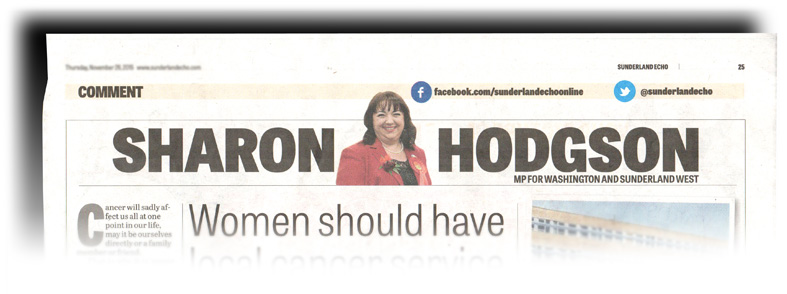
With Christmas around the corner, we are all getting into the full swing of the festivities this holiday season has to offer by visiting extended family we don’t get to see during the rest of the year, celebrating the end of the year with neighbours and work colleagues or just simply cosying up with a classic festive movie with our nearest and dearest on a cold winter’s night.
In the battle of the Christmas adverts, John Lewis, this year in partnership with Age UK, may not have been the tear-jerker of previous years but it did pack a punch in highlighting an issue that many of us forget when surrounded by our loved ones during the festive season: loneliness.
Loneliness can affect us all. This is more pertinent as we get older, with over one million older people saying they go without speaking to a friend, family member or neighbour for a month.
During the Christmas holidays, loneliness can be even harder to bear for older people who may have no loved ones around them with little, or no, festive celebrations to enjoy.
That is why it was so heart-warming to see one of the most high-profile and highly-anticipated adverts of the season highlight this important issue.
There is something we can all do this Christmas to support ending loneliness and end the perception that it is a normal part of ageing.
This includes putting pressure on the Government to consider loneliness as a public health problem that can be prevented and tackled.
If you support this, then you can sign Age UK’s petition on their website www.ageuk.org.uk/no-one
Tackling loneliness shouldn’t be just down to Government alone.
As individuals, we can do our own little bit to tackle loneliness, from a simple smile and a season’s greeting to an elderly neighbour you see walking down the street, to getting in touch with older relatives through a phone-call or a visit, or supporting our local Age UK here in Sunderland that works to help older people to enjoy the festive period.
That’s why when tucking into our dinner on Christmas Day or opening the next bottle of wine at the Christmas party, we must never forget those who will go lonely this Christmas and should pledge to do whatever we can, big or small, to make loneliness a thing of the past in 2016.
ECHO COLUMN: Making loneliness a thing of the past
Read Sharon's latest Sunderland Echo column below or find the published column on the Sunderland Echo's website. With Christmas around the corner, we are all getting into the full swing... Read more
Sharon has given her support to the relaunch of a cross-party manifesto that highlights the importance of acting early to enhance the outcomes for children.
Sharon has joined a wide-group of Members of Parliament from eight different parties who have thrown their support behind the relaunch of a key policy commitment to achieving better perinatal mental health and stronger attachment between babies, and their parents, right from the start.
The ‘1001 Critical Days Manifesto’ was launched in the last Parliament, when Sharon also supported the manifesto, and called for all political parties to incorporate their recommendations in their manifestos.
The 1001 Critical Days Manifesto takes its title from the period from conception to age 2 when a baby’s brain is developing fastest, and he or she is most susceptible to forming strong bonds of attachment with a primary carer, which will have lasting impact and certainly set a child up for the best start in life, in school and into adulthood.
As part of the relaunch, Sharon and other Members of Parliament are pressing Government ministers to adopt the manifesto’s pledges as policy across a number of Whitehall departments steered by the Department for Health.
Other parliamentarians supporting the manifesto, include: Tim Loughton MP, Norman Lamb MP, and Caroline Lucas MP.
Many of the social problems seen in society today are results of poor parenting skills often as a result of a parent having had a bad experience as a baby and creating a generational downward spiral.
The goal of the manifesto is for every baby to receive sensitive, appropriate and responsive care from their main caregivers in the first years of life with more proactive help from public bodies, like the NHS and children’s centres, in a joined-up preventative strategy that supports the greatest change and outcomes in a child’s life.
The new manifesto draws attention to statistics that show around 26% of babies (198,000) in the UK are estimated to be living within complex family situation, of heightened risk where there are problems with substance misuse, mental health or domestic violence, whilst 36% of serious case reviews involve a baby under the age of one.
Following the relaunch of the manifesto, Sharon said:
“It is fantastic to see the 1001 Critical Days manifesto relaunched in this Parliament with more Members of Parliament than ever before offering their support to raise awareness of the need to help parents in the first 1001 days of their baby’s life.
“The lack of early intervention policy by the Government to support parents and their babies in complex situations can lead to issues further down to the line, including around a child’s health, education, brain development and behaviour, and especially into adulthood and the costs incurred on the taxpayer when these issues could have been addressed at an early stage.
“That is why it is important that families are offered and provided with the necessary help at the earliest opportunity to end the generational cycle of disadvantage and I hope the Government will seriously listen to these concerns.”
Sharon supports relaunch of 1001 Critical Days Manifesto
Sharon has given her support to the relaunch of a cross-party manifesto that highlights the importance of acting early to enhance the outcomes for children. Sharon has joined a wide-group...

Sharon pictured here with Royal Mail postal workers at the Washington delivery office during her visit on National Postal Workers’ day 2015, before Christmas.
National Postal Workers' Day visit to Washington delivery office 2015
Sharon pictured here with Royal Mail postal workers at the Washington delivery office during her visit on National Postal Workers’ day 2015, before Christmas. Read more
This week in Parliament, Sharon helped announce the winners of the Kelloggs' Breakfast Club Awards 2015, which she also helped judge.

Sharon, pictured here with Liz McInnes MP, Member of Parliament for Heywood and Middleton and Shadow Communities and Local Government Minister.
There have been countless stories of children fainting during mid-morning lessons because of a lack of healthy food, or any food at all, on a morning or even the night before and are running on empty when they arrive at school to learn.
The Kellogg’s Breakfast Club Awards celebrates the best breakfast clubs from across the UK who help to address the issue of children going hungry before school and when the awards were announced in September over 500 schools entered.
Sharon took part as one of the expert judges of the awards, along with: Peter Watson, Primary Times Editor; Sally Whittle, writer of ‘Mummy Blogger’; Lindsay Graham, School Food Advisor; Professor Greta Defeyter, Director of Health Living at Northumbria University, and; Simon Langley, Headteacher of Broadstone Hall Primary School in Stockport, which was a previous winner of the Kelloggs’ Breakfast Club Awards.
On the day, Sharon presented the awards with Jonathan Myers, Kellogg’s Regional Vice-President for the UK and Ireland, and Mr Burton of Educating Yorkshire fame.
Each winner was awarded a prize of £1,500 for their breakfast club. The overall winner was given £2,000. A runner up from each category received £500.
Speaking after the event, Sharon (pictured above with Liz McInnes MP, Member of Parliament for Heywood and Middleton and Shadow Communities and Local Government Minister) said:
“Breakfast is the most important meal of the day and sadly in today’s society we see children fainting mid-morning because they haven’t received the food that morning to keep them going at school, or even the night before.
“That’s why it was wonderful to recognise all the hard work and dedication from the entries to the Kelloggs Breakfast Club Awards who provided a healthy breakfast to those children who need it, along with an enriching and educational environment to start their school day.
“Thanks must also go to Kelloggs for once again recognising the work that goes into providing breakfast clubs to children and young people, and I hope that after this year’s award there can be a real move forward in providing for those children and young people who go hungry at the beginning of the school day.”
The categories and winners of each are as below:
Long Life and Sustainability: Johnson Fold Primary School, Bolton
Extra Learning: South View Junior School, Basingstoke
Promoting a Healthy Lifestyle: The Rowans, Kent
Community Involvement: Severn View Food Project
Breakfast Club Hero: Helen Walker, Greenland Community Primary School, Co. Durham
Best Breakfast Club (Wales): Oakfield Primary School, Cardiff
Best Breakfast Club (Scotland): St Winnings Primary School, Kilwinning
Best Breakfast Club (Northern Ireland): Lisnagelvin Primary School, Londonderry
Best Breakfast Club (England): Penine Way Primary School, Carlisle
Overall Winner: Beechlawn School, County Down, Northern Ireland
To find out more about the Kellogg’s Breakfast Club Awards please follow the link, including a video from Mr Burton on the ‘Winners and Runners Up 2015’ webpage: http://www.kelloggs.co.uk/en_GB/kelloggs-breakfast-club-awards.html
Sharon announces winners of Kelloggs' Breakfast Club Awards 08.12.15
This week in Parliament, Sharon helped announce the winners of the Kelloggs' Breakfast Club Awards 2015, which she also helped judge. Sharon, pictured here with Liz McInnes MP, Member of...
Read Sharon's statement on Syria Air Strikes after a Parliamentary vote on 2nd December 2015.

On Wednesday 2nd December, Parliament spent a considerable amount of time debating the Government’s motion to extend military intervention against the so-called Islamic State/Daesh (IS/Daesh) in Iraq into Syria as a way of degrading this death cult’s regional and global threat.
Over the past week, I have received hundreds of messages from constituents, through social media, email and phoning my office, asking for me to vote against the Government’s proposed air strikes on IS/Daesh.
No one, who has watched the scenes coming out of Iraq and Syria on our TV screens, can fail to be shocked and appalled by the actions of IS/Daesh towards ethnic and religious minorities in the lands that they have brutally overtaken, the women and LGBT people they have persecuted, crucified and beheaded or the Muslims they have silenced, tortured and executed just because they have been brave enough to stand up against IS’s hate-fuelled interpretation of Islam.
The decision to extend military action into Syria has been a hard decision, where both sides of the argument must be weighed carefully. All military action must be contemplated with the full facts, serious discussions and with decisions never to be taken lightly.
That is why I decided to vote against the Government’s motion to bomb IS/Daesh in Syria, as I felt the facts put before us by the Prime Minister were not convincing enough to enter into what is a very complicated situation in Syria.
By the time of the vote, concerns had still not been answered in regards to:
- the lack of an intervention with the full backing of, and led by, the United Nations which would bring together all the world’s powers, including regional powers in the Middle-East, to work towards ending the scourge of IS/Daesh;
- no clear or coherent strategy when it came to post-conflict reconstruction that would allow the millions of Syrian refugees who have fled their homeland in recent years to safely return and rebuild their lives under a free and democratic government, and;
- a lack of a comprehensive strategy that doesn’t focus primarily on bombing but also includes economic sanctions against IS/Daesh and those who collude with them.
It is clear that we should, and must, work towards ending the violence in Syria and the threat that IS/Daesh is to the region and the wider world; however, the military plan put before Parliament by the Prime Minister did not go far enough in addressing the many concerns Members of Parliament and the wider public had before decision could be taken on air strikes in Syria.
Though the Prime Minister has now received the Parliamentary approval to enter into the war in Syria, this does not mean that he can ignore the concerns that people have put forward in the lead up to the vote.
At each stage of military intervention, the Prime Minister must make sure that he considers the concerns of the public as a whole and makes sure that past military mistakes in the region do not go ignored and exacerbate any further the on-going problems we are currently seeing in this turbulent region.
Sharon's statement on Syria Air Strikes vote 02.12.15
Read Sharon's statement on Syria Air Strikes after a Parliamentary vote on 2nd December 2015. On Wednesday 2nd December, Parliament spent a considerable amount of time debating the Government’s motion...
Sharon backs the launch of Labour’s campaign to remain in the European Union, "Labour In For Britain".

The Labour In For Britain Campaign was launched by the chair of the campaign, Alan Johnson MP, on Tuesday 1st December in the Midlands and is backed by 213 Labour MPs, including Labour Leader Jeremy Corbyn and the entire Shadow Cabinet.
Labour shares the aims and principles of the cross-party campaign, Britain Stronger in Europe, however Labour will be running its own distinct campaign that stresses Labour’s case for Britain’s continued EU membership.
Britain is a proud trading country with almost half of our exports going to EU countries, worth £227 billion last year to the UK’s economy. UK jobs and businesses, large and small, depend on trade with Europe.
The North-East is the only net exporter in the UK to the European Union with many businesses, including Nissan in Sunderland, relying upon the close trade links with the European Union.
The UK also receives on average £26.5 billion of investment every year from other EU countries and future EU trade could create 790,000 more jobs by 2030 by opening up new markets in Europe, for British businesses, like digital services, energy and tourism.
Labour is campaigning to stay in Europe on the basis that continued membership is good for British jobs and good for men and women working in those industries.
It was Labour who made sure that Britain’s EU membership gave British worker’s rights to minimum paid leave, rights for agency workers, paid maternity and paternity leave, equal pay, anti-discrimination laws, and protection for the workforce when companies change ownership.
Following the launch of the Labour In For Britain campaign, Sharon said:
“In the weeks and months ahead, it is important that the case for our continued membership of the European Union and the benefits this brings to working families here in Sunderland and the North-East is made.
“The North-East and the wider country’s economic future depends on trading with other EU countries as a key trading partner and receiving investment from businesses who want to work within the European Union, such as Nissan.
“That is why I am proud to support Labour’s In For Britain campaign to make the case for the UK’s future as part of the European Union.”
You can watch Labour's In For Britain campaign video below or find out more on the website here.
Sharon backs Labour's In For Britain campaign
Sharon backs the launch of Labour’s campaign to remain in the European Union, "Labour In For Britain". The Labour In For Britain Campaign was launched by the chair of the...
Sharon Hodgson has joined Shadow Business Secretary, Angela Eagle MP in celebrating the contribution of small business as part of this year’s Small Business Saturday (SBS) on December 5th.

In the lead up to and on the day, shoppers are being encouraged to ‘shop small’ and celebrate the contribution of entrepreneurs and small firms this coming weekend.
Small Business Saturday was launched in 2013 after then Shadow Business Secretary, Chukka Umunna MP, saw the benefits of celebrating small businesses as was seen in the USA.
The day has become a celebration of local small businesses that crosses party-political lines and brings together shoppers, businesses and politicians to celebrate the contributions of small businesses to the UK’s economy.
Small Business Saturday has brought a boost to local high streets across the country and in 2014, 16.5 million people visited local independent stores – 2.7 million more than on SBS in 2013.
Sharon is backing local businesses to take advantage of the campaign on a key shopping day in the year in the run-up to Christmas and encouraging local people to shop locally in small firms as part of SBS. The day aims to give a long-term boost to trade and give a lift to our high streets.
In the lead up to the event, Sharon said:
“Small businesses here in Washington and Sunderland West are vital to our local economy. From the store owners at the Market Village in The Galleries to the many local independent shops on our high streets, they all provide the vibrancy and choice that local people want when going shopping, especially in the lead up to the holiday season.
“That is why I am backing Small Business Saturday and encouraging local people to shop locally and help raise awareness of the important value our small local businesses play and help to boost trade in our area.”
Angela Eagle MP, Labour’s Shadow Secretary of State for Business, Innovation and Skills, said:
“Small Business Saturday is growing bigger and better every year, it’s such an important day because it puts small businesses in the spotlight and encourages people to shop locally not only on one of the busiest shopping days of the year but also to encourage a long-term commitment. It provides a great opportunity to thank those who run Britain’s small firms.
“Labour wants to do more to help our risk takers and wealth creators, by helping businesses with the challenges they face on issues like access to finances and late payments. We’ll work in partnership with businesses, entrepreneurs and workers to create a stronger economy.”
For more on Small Business Saturday see https://smallbusinesssaturdayuk.com/
Sharon Hodgson backs Small Business Saturday 05.12.15
Sharon Hodgson has joined Shadow Business Secretary, Angela Eagle MP in celebrating the contribution of small business as part of this year’s Small Business Saturday (SBS) on December 5th. In...